
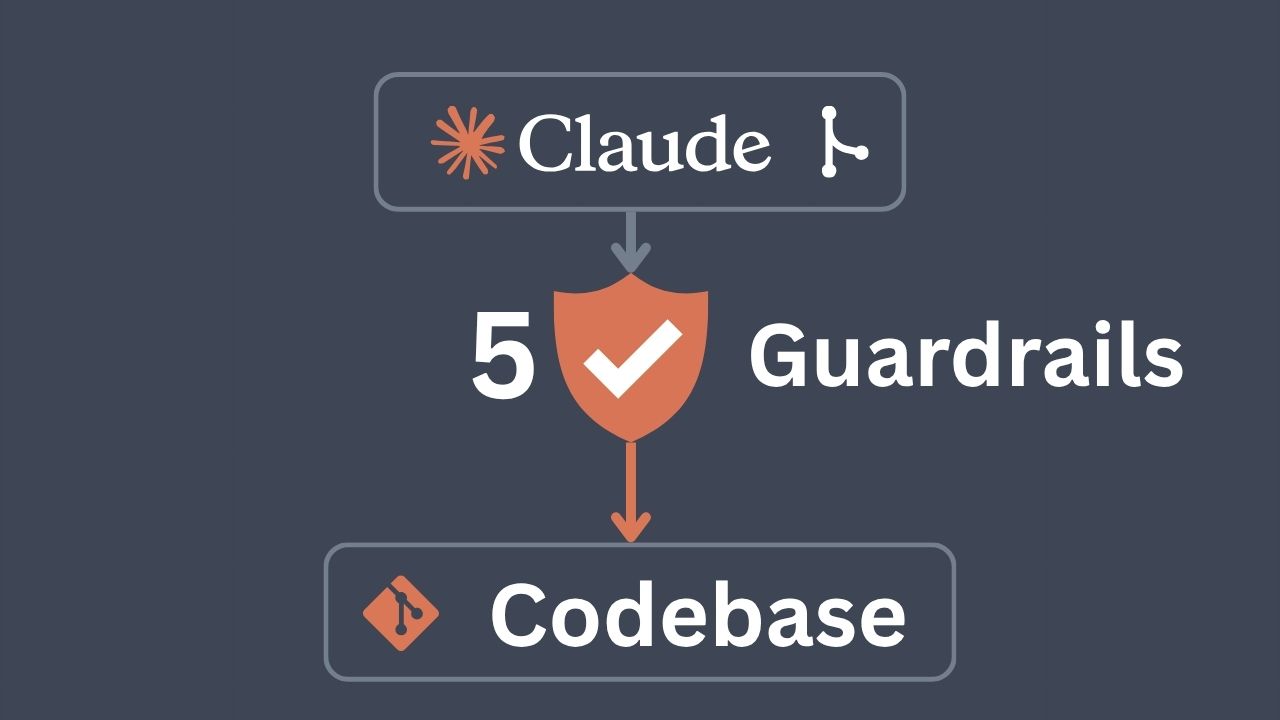
Production-safe AI code: the framework
If you are using AI tools (Claude Code, Cursor, Copilot) to write code that will run in production, this is the framework I apply to my own work and teach through the YouTube channel and the written guides on this site.
The premise is simple: AI-generated code is plausible by default, but not correct by default. Plausibility passes a casual review. Correctness requires explicit checks.
Who this is for:
- Engineers shipping AI-generated code to production
- Tech leads writing review guidelines for AI-assisted work
- Engineering managers worried about quality regressions from AI adoption
Last updated: May 2026 by Jitan Gupta, Mumbai-based AI adoption practitioner.
The five checks
Before any AI-generated change reaches main, run these five checks in order. The video below walks through each with real examples.
1. Correctness: does it actually do what you asked?
The single most common failure: the AI confidently writes code that solves a slightly different problem than the one you described. Read every line. Run it on edge cases the AI did not test for. If the function takes a list, try an empty list. If it parses dates, try invalid input.
2. Scope: did it stay inside the lines?
AI tools love to “improve” adjacent code. A request to fix a bug becomes a refactor of the surrounding module. Diff every changed file. Reject any change that was not asked for, even if it looks like an improvement. Scope creep in PR review is bad. Scope creep from AI is worse, because no human author thought about backward compatibility.
3. Security: are there new attack surfaces?
AI generates SQL strings, shell commands, and HTTP handlers freely. Audit every new external input, every new dependency, every new query. Look specifically for: string concatenation in SQL, unsanitized user input reaching a shell, broad exception handlers that hide security failures, hardcoded secrets, and overly permissive defaults.
4. Performance: what is the hidden cost?
AI-generated code prefers readability over efficiency. That is usually fine. The trap is when “readable” code hides an N+1 query, an O(n²) loop, or a synchronous call inside a request handler. For any non-trivial change, run it under realistic data volumes before merging.
5. Observability: can you tell if it broke?
Add a log line, a metric, or a trace span at every new decision point. If the AI-generated code makes an HTTP request, log it. If it writes to a database, count it. The cost is one line per addition. The benefit is being able to debug it at 3 AM.
The artifacts behind this framework
This is not theoretical. The 5-Check framework comes from real work:
- cb-mcp-server: I ran every change through these checks during the public build log. The commit history shows the discipline.
- Content Board: a production PWA where AI wrote roughly 60% of the code. Every merge passed the five checks.
Related reading on this site
- Claude Code Training in India: the workflow side of AI adoption, where the 5-Check framework gets applied.
- Claude Code Windows installation guide: the prerequisite if you are not yet running Claude Code locally.
For the canonical specs:
Want this wired into your team’s review process?
The framework is free, open, and yours to adopt. The video above walks through each check with real examples, and the artifacts linked earlier show it applied commit by commit. If you adopt it and something doesn’t fit your team’s workflow, tell me — the framework improves when people push back on it.
Watch on YouTube
Don't Ship AI Code Before These 5 Checks