
The $50K Weekend: When Force Upgrades Go Wrong
It’s Saturday morning. Your deployment pipeline kicks off an upgrade across 400 tenants in the US-East region. Fourteen microservices roll out sequentially. By Sunday evening, your on-call team is drowning in escalations: three key accounts are down, billing is broken, and you’re facing 28 engineer-hours of rollbacks across all services.
The worst part? Only 8 of those 400 tenants actually needed this upgrade. The other 392 were running perfectly fine on the previous version.
This isn’t a hypothetical. This is the reality of multi-tenant SaaS deployments when you treat 400 unique businesses as a single deployment target.
The question: Could we have known which tenants to upgrade and which to leave alone?
The answer: Yes, with probabilistic reasoning and AI orchestration.
Status: What follows is a working end-to-end POC — the RAG pipeline, reasoning engine, and GitOps integration all run. It is not yet adopted in production, and all savings figures below are modeled, not measured.
The Problem: Why Region-Based Deployments Aren’t Enough
Multi-tenant SaaS platforms face an impossible dilemma:
- Deploy aggressively: Ship weekly hotfixes to fix bugs fast → Risk breaking stable tenants who don’t need the fix
- Deploy conservatively: Test exhaustively, upgrade only when certain → Miss SLA commitments, accumulate tech debt
The traditional deployment model (force upgrade all tenants in a region) treats tenants as identical when they’re anything but:
- Tenant A: Uses 9 features heavily, high daily usage, low risk tolerance (key account)
- Tenant B: Uses 3 features lightly, tolerates bugs, prefers stability over features
- Tenant C: Early adopter, wants cutting-edge features, willing to accept risk
Yet all three get the same upgrade at the same time, regardless of whether they need it.
The Manual Alternative Is Worse
The alternative (manually deciding which tenants to upgrade) requires a product manager to:
- Read 50+ Jira tickets from the release
- Cross-reference tenant feature usage from analytics dashboards
- Guess which tenants are likely to hit specific bugs
- Create a spreadsheet mapping tenants to risk levels
- Argue with DevOps about the deployment schedule
Time cost: 2 hours per release
Accuracy: ~60% (educated guessing)
Scalability: Breaks down beyond 100 tenants
The Missing Piece: Per-Tenant Risk Assessment
What’s needed isn’t just “does this tenant use Feature X?” but:
- Will this tenant hit this specific bug?
- What’s the probability of impact based on their usage patterns?
- Should we upgrade them now or wait?
This requires probabilistic reasoning, not boolean feature flags.
The Insight: From Feature Flags to Usage Probability
Traditional deployment logic is binary:
IF tenant.uses(F3_Subscription) AND release.affects(F3_Subscription):
    UPGRADE tenant
But reality is probabilistic:
IF tenant.uses(F3_Subscription)
   AND release.has_bug(F3_Proration)
   AND tenant.uses(multi_year_contracts)  # ← The critical detail
   AND bug.severity == CRITICAL:
    MUST UPGRADE (probability: 85%)
ELSE IF tenant.uses(F3_Subscription)
   AND bug.affects(edge_case_workflow)
   AND tenant.risk_tolerance == HIGH:
    SKIP UPGRADE (probability: 15%)
Real-World Example: F3 Proration Bug
The Bug: Critical flaw in proration logic for multi-year contracts causing SQL constraint violations during plan downgrades.
Naive Approach:
- 50 tenants use F3_Subscription
- Decision: Upgrade all 50
Probabilistic Approach:
- 50 tenants use F3_Subscription
- Only 8 tenants have multi-year contracts (bug trigger condition)
- 5 of those 8 are key accounts (low risk tolerance)
- Decision:
- MUST upgrade: 5 key accounts (probability: 90%)
- SHOULD upgrade: 3 standard accounts (probability: 60%)
- SKIP upgrade: 42 unaffected tenants (probability: 5%)
Result: 42 tenants stay on a stable version, avoiding unnecessary deployment risk.
This is probabilistic deployment: treating each tenant as a unique risk profile, not a checkbox.
The Architecture: RAG + LLM + Tenant Profiling
The system combines three intelligence layers to generate per-tenant upgrade recommendations:
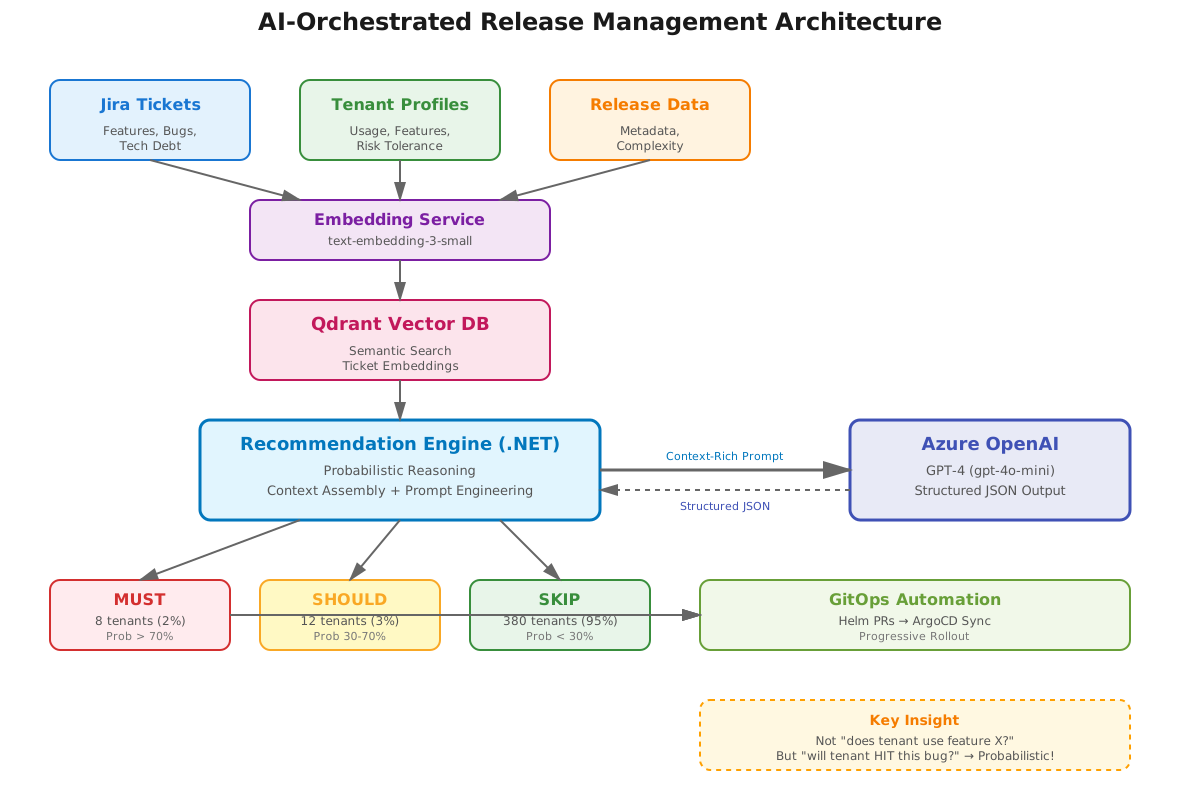
Layer 1: Data Collection & Vectorization
Jira Tickets → Semantic Search
- All release tickets (features, bugs, tech debt) embedded using
text-embedding-3-small - Stored in Qdrant vector database for semantic retrieval
- Includes: bug descriptions, affected modules, customer reports, resolution details
Tenant Profiles → Usage Intelligence
- Active features (F1-F10) from audit logs
- Usage patterns (high/medium/low daily activity)
- Risk tolerance (derived from SLA tier, account size, compliance requirements)
- Historical incident data (past bugs, escalations)
Release Metadata → Context
- Deployment complexity (HELM changes, DB migrations)
- Feature breakdown (new features vs. bug fixes)
- Cross-feature dependencies
Layer 2: Probabilistic Reasoning Engine
When a release stabilizes (passes canary deployment), the system:
- Semantic Search: For each tenant, retrieve relevant tickets based on their active features
- Context Assembly: Build a prompt containing:
- Tenant profile (features, usage, risk tolerance)
- Retrieved tickets (bug details, affected modules)
- Release metadata (complexity, deployment impact)
- LLM Reasoning: GPT-4 generates a recommendation with probabilistic assessment
The Secret Sauce: Likelihood Assessment Checklist
// From the actual implementation
var impactProbability = 0;

// 1. Core workflow usage? (+40%)
if (tenant.UsesFeatureDaily(bug.LinkedFeatureId))
    impactProbability += 40;

// 2. Widespread vs. edge case? (+30% or +5%)
if (bug.ReportedByMultipleTenants)
    impactProbability += 30;
else if (bug.IsEdgeCase)
    impactProbability += 5;

// 3. Tenant profile matches bug conditions? (+30% or -50%)
if (tenant.ProfileMatchesBugTrigger(bug))
    impactProbability += 30;
else
    impactProbability -= 50;

// 4. Severity adjustment (+20% for data/security)
if (bug.Severity == "CRITICAL" && bug.Type == "DATA_LOSS")
    impactProbability += 20;

// Decision thresholds
if (impactProbability > 70)
    return "MUST";
else if (impactProbability > 30)
    return "SHOULD";
else
    return "SKIP";
This isn’t hard-coded rules. It’s feature-based scoring that the LLM uses as guidance.
Layer 3: Decision Output & GitOps Integration
Recommendation Format:
{
  "tenantId": "T-CORP-401",
  "recommendation": "MUST",
  "reasoning": "CRITICAL proration bug in F3. Tenant uses multi-year contracts heavily (85 daily transactions). 90% probability of hitting SQL constraint violation. Low risk tolerance (key account) requires immediate upgrade.",
  "affectedFeatures": ["F3_Subscription", "F4_Billing"],
  "estimatedImpact": "high",
  "deploymentWindow": "2025-12-15 02:00 UTC"
}
Human-in-the-Loop:
- AI generates recommendations
- Product/DevOps reviews for sanity check
- Approved recommendations trigger PR creation in Helm repo
- ArgoCD picks up changes and deploys per-tenant
The Implementation: Code That Thinks
Prompt Engineering: Probabilistic Decision Framework
The LLM receives this structured prompt for each tenant:
private string BuildPrompt(TenantProfile tenant, ReleaseContext releaseContext)
{
    return $@"
You are analyzing whether tenant {tenant.TenantId} should upgrade to {releaseContext.ReleaseVersion}.

**CRITICAL INSTRUCTION**: Use PROBABILISTIC REASONING. Don't just check if a feature has a bug.
Assess the LIKELIHOOD that this specific tenant is experiencing the bug based on their usage
profile, risk tolerance, and bug characteristics.

**Tenant Profile:**
- Tenant ID: {tenant.TenantId}
- Active Features: {string.Join(", ", tenant.ActiveFeatures)}
- Usage Pattern: {tenant.UsagePattern} (daily activity score: {tenant.DailyUsageScore})
- Risk Tolerance: {tenant.RiskTolerance}

**Release: {releaseContext.ReleaseVersion}**
- Deployment Complexity: {releaseContext.Metadata.DeploymentComplexity}
- Total Changes: {releaseContext.Metadata.ContentBreakdown.Count}

**Changes Affecting This Tenant:**
{BuildImpactAnalysis(tenant, releaseContext)}

**Relevant Tickets (RAG Results):**
{string.Join("\n", releaseContext.RelevantTickets.Select(t =>
    $"- [{t.Type}] {t.TicketId}: {t.Summary}\n  Features: {string.Join(", ", t.AffectedFeatures)}"))}

**Probabilistic Decision Framework:**

MUST Upgrade = HIGH probability (>70%) tenant is experiencing or will soon experience critical impact:
1. CRITICAL security vulnerability in authentication/payment features they actively use
2. CRITICAL data corruption/loss bugs in features with HIGH daily usage
3. Compliance violations with immediate legal/financial consequences
4. LOW risk tolerance + CRITICAL bug in core business feature

SHOULD Upgrade = MEDIUM probability (30-70%) of impact OR non-critical improvements worth deploying:
1. MAJOR bugs in frequently used features affecting subset of workflows
2. Edge case CRITICAL bugs tenant might encounter occasionally
3. Performance/stability MAJOR fixes for HIGH usage tenants

SKIP Upgrade = LOW probability (<30%) of impact OR minimal benefit vs. deployment cost:
1. Only MINOR/PATCH bugs in their features (UI typos, cosmetic issues)
2. MAJOR/CRITICAL bugs in features they DON'T use at all
3. HIGH risk tolerance + edge case bugs in non-core features
4. New features tenant hasn't requested (no value, just deployment risk)

**Bug Likelihood Assessment Checklist:**
1. Is this bug affecting a core workflow tenant uses daily? (YES = +40% probability)
2. Is this bug widespread or an edge case? (Widespread = +30%, Edge case = +5%)
3. Does tenant's profile match the bug's conditions? (Match = +30%, No match = -50%)
4. Is this a data corruption/security bug vs. UX bug? (Data/Security = +20%)

**Output Format (JSON only):**
{{
  ""recommendation"": ""MUST|SHOULD|SKIP"",
  ""reasoning"": ""State the PROBABILITY of impact and WHY."",
  ""affectedFeatures"": [""feature1"", ""feature2""],
  ""estimatedImpact"": ""high|medium|low""
}}
";
}
The Decision Logic: Not Just Rules, Intelligence
public async Task<UpgradeRecommendation> GenerateRecommendationAsync(
    TenantProfile tenant,
    ReleaseContext releaseContext)
{
    // 1. Build context-rich prompt
    var prompt = BuildPrompt(tenant, releaseContext);

    // 2. Save for audit trail
    await SavePromptAsync(tenant, prompt);

    // 3. Call LLM with system message
    var messages = new List<ChatMessage>
    {
        new SystemChatMessage(
            "You are an expert system that analyzes software releases and " +
            "generates upgrade recommendations using probabilistic reasoning."),
        new UserChatMessage(prompt)
    };

    var response = await _chatClient.CompleteChatAsync(messages);
    var content = response.Value.Content[0].Text;

    // 4. Parse structured JSON response
    var recommendation = ParseRecommendation(content, tenant.TenantId, releaseContext.ReleaseVersion);

    return recommendation;
}
Impact Analysis: The Critical Context
private string BuildImpactAnalysis(TenantProfile tenant, ReleaseContext releaseContext)
{
    var criticalChanges = releaseContext.Metadata.ContentBreakdown
        .Where(c => tenant.ActiveFeatures.Contains(c.LinkedFeatureId) && c.Severity == "CRITICAL")
        .ToList();

    var majorChanges = releaseContext.Metadata.ContentBreakdown
        .Where(c => tenant.ActiveFeatures.Contains(c.LinkedFeatureId) && c.Severity == "MAJOR")
        .ToList();

    if (!criticalChanges.Any() && !majorChanges.Any())
        return "No CRITICAL or MAJOR changes affect this tenant's active features. " +
               "Release primarily contains updates to features this tenant doesn't use.";

    var analysis = "";

    if (criticalChanges.Any())
    {
        analysis += $"- **CRITICAL Changes**: {criticalChanges.Count} affecting " +
                   $"{string.Join(", ", criticalChanges.Select(c => c.LinkedFeatureId).Distinct())}\n";
        analysis += $"  Tickets: {string.Join(", ", criticalChanges.Select(c => c.ChangeId))}\n";
    }

    if (majorChanges.Any())
    {
        analysis += $"- **MAJOR Changes**: {majorChanges.Count} affecting " +
                   $"{string.Join(", ", majorChanges.Select(c => c.LinkedFeatureId).Distinct())}\n";
    }

    // Probabilistic context
    if (criticalChanges.Any() && tenant.RiskTolerance.ToLower() == "low")
    {
        analysis += "\n**Probabilistic Assessment:**\n";
        analysis += "- LOW risk tolerance + CRITICAL bugs = HIGH impact probability (>70%) → likely MUST upgrade.\n";
    }
    else if (!criticalChanges.Any() && majorChanges.Any() && tenant.RiskTolerance.ToLower() == "high")
    {
        analysis += "\n**Probabilistic Assessment:**\n";
        analysis += "- HIGH risk tolerance + only MAJOR bugs = LOW impact probability → likely SKIP unless high-frequency workflows affected.\n";
    }

    return analysis;
}
The Math: The Modeled Savings
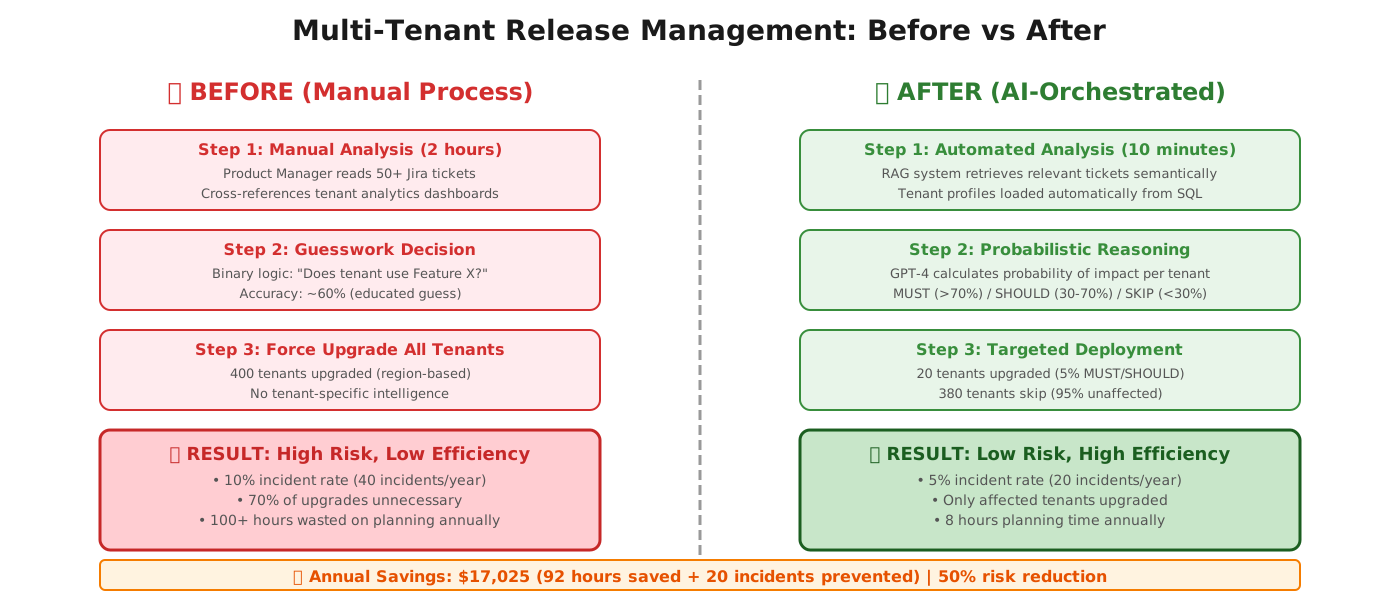
Current State (Force Upgrade Model)
Annual Release Cadence:
- 4 major releases per quarter = 4 releases
- 1-2 hotfixes per week = 50-100 hotfixes
- Total: ~50 deployments per year
Cost per Deployment:
- Manual release planning: 2 hours × $100/hour = $200
- Incident rate: 10% of deployments cause rollback
- Rollback cost: 14 services × 1.5 hours × $150/hour = $3,150 per incident
- Annual cost: $200 × 50 + $3,150 × 5 = $10,000 + $15,750 = $25,750
With AI Orchestration
Time Savings (designed):
- Release planning: 2 hours → 10 minutes = 1.83 hours saved per release
- Modeled annual savings: 1.83 hours × 50 releases × $100/hour = $9,150
Risk Reduction (projected):
- 70% of tenants can SKIP non-critical upgrades
- Fewer unnecessary deployments = lower incident rate (10% → 5%)
- Incidents avoided: 5 → 2.5 per year
- Modeled annual savings: 2.5 incidents × $3,150 = $7,875
Modeled Annual ROI:
- Projected direct savings: $9,150 + $7,875 = ~$17,025
- Indirect benefits:
- Faster time-to-market (no 2-hour planning bottleneck)
- Improved tenant satisfaction (fewer disruptive upgrades)
- Reduced on-call burden (fewer weekend incidents)
For a 400-tenant platform: ~$17K+ in modeled annual savings
For a 1,000-tenant platform: ~$40K+ in modeled annual savings
Decision Flow: From Release to Recommendation
graph TD
    A[New Release v1.6.0<br/>24 Stories + 15 Bugs] --> B[Canary Deployment<br/>5% Test Tenants]
    B --> C{Canary<br/>Stable?}
    C -->|48h Pass| D[Vectorize Tickets<br/>Qdrant + text-embedding-3]
    C -->|Failed| Z[Rollback & Fix]

    D --> E[For Each Tenant<br/>n=400]

    E --> F[Load Tenant Profile<br/>Features: F1,F3,F4<br/>Usage: HIGH<br/>Risk: LOW]

    F --> G[Semantic Search<br/>Query: 'F3 F4 subscription billing'<br/>Returns: Top 10 Tickets]

    G --> H[Build Context Prompt<br/>Tenant + Tickets + Framework]

    H --> I[LLM Reasoning<br/>GPT-4 + Probabilistic Logic]

    I --> J{Probability<br/>Assessment}

    J -->|>70%| K[MUST Upgrade<br/>8 tenants 2%]
    J -->|30-70%| L[SHOULD Upgrade<br/>12 tenants 3%]
    J -->|<30%| M[SKIP Upgrade<br/>380 tenants 95%]

    K --> N[Human Review<br/>Product Manager]
    L --> N
    M --> N

    N --> O{Approved?}

    O -->|Yes| P[Create Helm PRs<br/>Per Tenant]
    O -->|No| Q[Adjust Recommendations]

    P --> R[ArgoCD Sync<br/>Progressive Rollout]

    R --> S[MUST → SHOULD → SKIP]

    S --> T[Monitor & Validate]

    T --> U{Incidents?}

    U -->|Yes| V[Rollback Affected<br/>Learn for Next Release]
    U -->|No| W[Success<br/>Update Tenant Versions]

    style K fill:#ff6b6b
    style L fill:#ffd93d
    style M fill:#6bcf7f
    style I fill:#4d96ff
    style N fill:#a78bfa
What This Enables: The Future of Multi-Tenant GitOps
1. Intelligent Long-Term Support (LTS)
Multi-tenant SaaS often offers 1-year LTS per release:
- Tenants can skip up to 3 releases if stable
- Force upgrade only when:
- Security vulnerability affects them
- Critical bug impacts their workflow
- New feature they requested is available
With AI orchestration: The system automatically determines when to end LTS support per tenant.
2. Compliance-Driven Deployments
Regulated industries (healthcare, finance) have strict change control:
- Every deployment requires justification
- Risk assessment must be documented
- Rollback plans must be pre-approved
With AI orchestration: The system generates audit-ready justifications with probabilistic reasoning.
3. Cost-Optimized Infrastructure
Cloud costs scale with deployment frequency:
- Fewer unnecessary deployments = lower compute costs
- Fewer rollbacks = less wasted CI/CD time
- Tenant-specific deployment windows = better resource utilization
With AI orchestration: Deploy only when value exceeds cost.
4. Tenant-Specific Release Notes
Instead of generic release notes, generate personalized summaries:
- “This upgrade fixes 3 bugs that affect your workflows”
- “This upgrade adds features you requested last quarter”
- “You can safely skip this upgrade. No impact to your usage.”
With AI orchestration: LLM generates tenant-specific release notes from the same RAG pipeline.
Implementation Roadmap: From POC to Production
Phase 1: Foundation (Weeks 1-2)
- Set up Azure OpenAI + Qdrant infrastructure
- Build Jira ticket ingestion pipeline
- Create tenant profiling service (usage analytics)
- Deliverable: Working RAG system with semantic search
Phase 2: Intelligence Layer (Weeks 3-4)
- Implement probabilistic reasoning engine
- Build prompt engineering templates
- Create recommendation service with LLM integration
- Deliverable: System generates recommendations for sample tenants
Phase 3: GitOps Integration (Weeks 5-6)
- Integrate with Helm chart repository
- Build PR automation for approved upgrades
- Connect to ArgoCD for deployment sync
- Deliverable: End-to-end automated deployment flow
Phase 4: Production Hardening (Weeks 7-8)
- Add human review UI (approval dashboard)
- Implement audit logging and traceability
- Build monitoring and alerting
- Deliverable: Production-ready system with safeguards
Phase 5: Optimization (Ongoing)
- Refine probabilistic scoring based on outcomes
- Add feedback loop (did tenant experience bug?)
- Expand feature coverage (auto-detect new patterns)
- Deliverable: Self-improving system with learning loop
Key Takeaways
For Senior Engineers:
- This isn’t just LLM + database - it’s probabilistic reasoning applied to deployment decisions
- The stack is production-grade - RAG + Azure AI Foundry + Qdrant, and the POC runs end-to-end
- The code is real - .NET implementation with prompt engineering and structured outputs
- It’s adaptable - Works for any multi-tenant SaaS with structured release data
For Decision Makers:
- ROI is modeled - ~$17K+ projected annual savings for 400-tenant platforms
- Risk reduction by design - Fewer incidents, fewer rollbacks, better tenant satisfaction
- Time savings by design - 2 hours → 10 minutes per release planning cycle
- Scale is built in - The approach works for 100 tenants or 10,000 tenants
For Platform Architects:
- This is the missing piece - GitOps handles how to deploy, this handles when to deploy
- It’s not binary - MUST/SHOULD/SKIP framework enables nuanced decision-making
- It’s auditable - Every decision has LLM-generated reasoning for compliance
- It’s extensible - Add more data sources (logs, metrics, support tickets) to improve accuracy
Where It Stands
Currently a working POC; driving adoption is the next phase. The build is real — the RAG pipeline, the probabilistic reasoning engine, and the GitOps integration all run end-to-end. What’s left is the organizational work: earning the trust of the people who own the deploy button.
Working on Similar Problems?
This POC sits at the intersection I care most about: taking LLMs out of the demo phase and wiring them into real operational decisions — with the guardrails, auditability, and skepticism that production systems demand.
If your team is building in this space — applied AI on top of real infrastructure, multi-tenant platforms, deployment intelligence — I’d genuinely enjoy comparing notes. And if you’re hiring for Forward Deployed, Applied AI, or AI Platform Engineering roles, this case study is a fair sample of how I work: build the thing end-to-end, measure it honestly, and write down what’s still unproven.
Get in touch — I’m open to full-time roles, globally remote or with relocation.
About the Author
Jitan Gupta is a Senior Engineer with 9.5 years of development experience, specializing in cloud infrastructure, Kubernetes orchestration, and AI-powered operational tools. Currently leading an AKS migration for a 400+ tenant SaaS platform, he combines deep technical expertise with business operations experience to build systems that solve real problems.
Areas of Expertise:
- Azure infrastructure (AKS, Application Gateway, AGIC, YARP)
- Multi-tenant SaaS architecture and zero-downtime migrations
- AI/LLM integration for operational intelligence
- GitOps workflows (ArgoCD, Helm, Kubernetes)
Let’s Connect:
- Website: jitangupta.com
- GitHub: github.com/jitangupta (full source code coming soon)
- LinkedIn: linkedin.com/in/jitangupta
Appendix: Technical Deep Dive
A1: Tenant Profile Schema
{
  "tenantId": "T-CORP-401",
  "activeFeatures": [
    "F1_Authentication",
    "F3_SubscriptionMgmt",
    "F4_BillingPayments",
    "F6_InvoicingTax",
    "F7_Notifications",
    "F9_API"
  ],
  "usagePattern": "HIGH",
  "dailyUsageScore": 85,
  "riskTolerance": "LOW",
  "isKeyAccount": true,
  "totalSubscriptions": 15000,
  "complianceRequirements": ["SOC2", "HIPAA"],
  "preferredDeploymentWindow": "Saturday 02:00-06:00 UTC"
}
A2: Release Context Schema
{
  "releaseVersion": "v1.6.0",
  "releaseDate": "2025-12-15",
  "deploymentComplexity": "MEDIUM",
  "releaseSummary": "F10 tenant administration features + critical F3/F4/F6 bug fixes",
  "contentBreakdown": [
    {
      "changeId": "JIRA-6015",
      "type": "Bug",
      "severity": "CRITICAL",
      "linkedFeatureId": "F3_SubscriptionMgmt",
      "summary": "Proration logic throws SQL error on plan downgrade",
      "deploymentImpact": "NONE"
    },
    {
      "changeId": "JIRA-6022",
      "type": "Bug",
      "severity": "CRITICAL",
      "linkedFeatureId": "F4_BillingPayments",
      "summary": "Stripe webhook retry floods customer systems",
      "deploymentImpact": "HELM_CHANGE"
    }
  ]
}
A3: Vector Database Query Example
// Semantic search in Qdrant for tenant-relevant tickets
var queryVector = await _embeddingService.GenerateEmbeddingAsync(
    $"Features: {string.Join(" ", tenant.ActiveFeatures)} " +
    $"Usage: {tenant.UsagePattern} " +
    $"Concerns: subscription billing invoicing"
);

var searchResults = await _qdrantClient.SearchAsync(
    collectionName: "release-tickets",
    vector: queryVector,
    limit: 10,
    filter: new Filter
    {
        Must = new List<Condition>
        {
            new Condition
            {
                Key = "release_version",
                Match = new Match { Value = "v1.6.0" }
            }
        }
    }
);
A4: Sample LLM Output
{
  "recommendation": "MUST",
  "reasoning": "CRITICAL proration bug (JIRA-6015) in F3_SubscriptionMgmt directly affects this tenant. They process 85 subscription changes daily, heavily use multi-year contracts (bug trigger condition), and are a key account with LOW risk tolerance. Probability of impact: 90%. CRITICAL Stripe retry bug (JIRA-6022) also affects their webhook integrations. Both bugs have high likelihood of causing production incidents for this tenant.",
  "affectedFeatures": ["F3_SubscriptionMgmt", "F4_BillingPayments"],
  "estimatedImpact": "high",
  "deploymentPriority": 1,
  "recommendedWindow": "2025-12-15 02:00 UTC"
}
End of Case Study
Last Updated: December 2025
Version: 1.0
Additional Resources
- Source Code: GitHub repository (coming soon)
- Demo Video: YouTube walkthrough (coming soon)
- Technical Documentation: Full API reference and deployment guide
- Case Studies: Real-world implementation examples (anonymous)
Working on similar deployment challenges? I’d love to hear about it.